

Prime minister Andy Brunham, Prime Minister of the United Kingdom since July, has inherited a difficult economic situation. The United Kingdom is navigating the second half of 2026 against a difficult combination of weak growth and above-target inflation, which are the characteristics of a stagflationary environment. Together with the new Chancellor, John Healey, the new Prime Minister pledged a "new economic model" centred on investment and industrial renewal. In this article, we discuss the inflation and growth pressures confronting the new Prime Minister and his Chancellor, and how the interaction between monetary and fiscal policy will determine whether stagflationary risks can be mitigated.
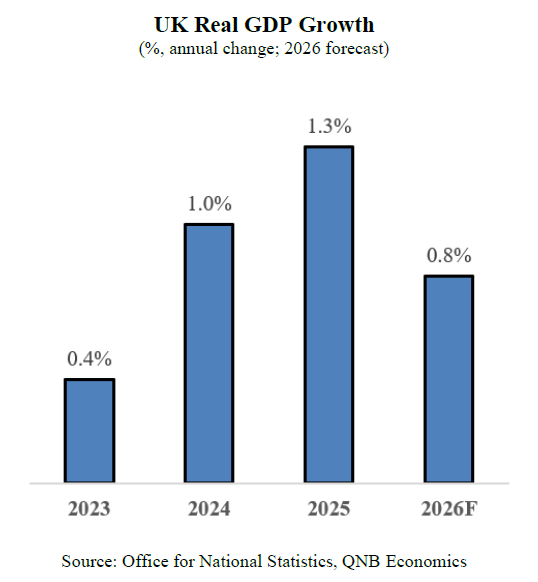
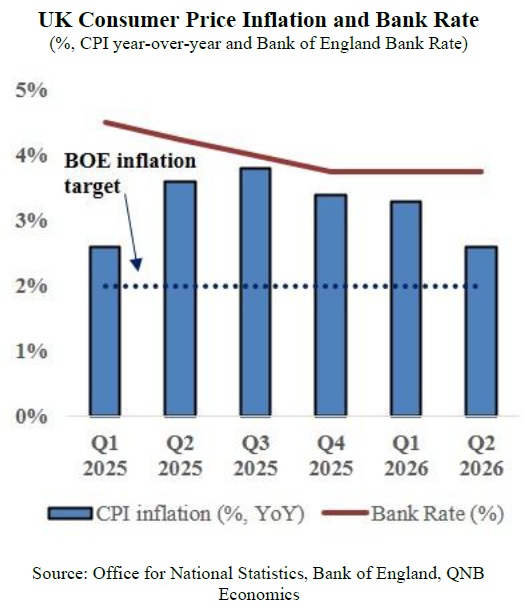
First, the UK economy is exhibiting clear stagflationary risks, with economic growth barely in the positive territory and consumer price inflation remaining above the Bank of England's (BoE) 2% target. The economy has struggled for momentum, expanding by around 1% in each of the past two years, with a similar or softer pace expected in 2026. This deceleration is driven by constrained consumer spending from high taxes and frozen tax thresholds, rising global energy costs, sluggish business investment, and the lingering lag effects of past interest rate hikes. In addition, the labour market indicators have also begun to cool, with hiring becoming more cautious. On the inflation side, headline consumer price inflation reached a peak earlier in the year, when the global energy price shock pushed costs higher. Yet even with the moderation of the energy pressures, domestically generated inflation is proving quite sticky. The Office for National Statistics notes ongoing risks from persistent domestic wage growth and corporate pricing strategies adjusting to earlier cost spikes.
Second, monetary policy in the UK is set independently of the government, with the BoE mandated to deliver price stability while supporting the wider economy. Currently, the BoE finds itself in the middle to a potential stagflation dilemma: cutting interest rates too quickly risks reigniting price pressures and inflation, while holding them too high for too long risks deepening the stagnation and potentially a recession. The BoE has signalled a "gradual and careful" approach, keeping policy modestly restrictive at 3.75%, weighing competing risks to prices and economic activity, and only moving as the evidence on underlying inflation becomes clearer. This explains why the Monetary Policy Committee has resisted calls to lower rates, and why a hawkish minority of members have argued for further tightening, wary that easing prematurely could allow inflation expectations to become entrenched.
Third, fiscal policy flexibility will be constrained by the high government debt levels and statutory fiscal rules. The UK government borrowing costs are among the highest in the advanced economies, with ten-year gilt yields around 5% and public debt close to 100% of GDP. Debt-servicing costs now absorb a substantial share of public revenue, leaving little margin for error. Financial markets proved sensitive to early signals that the new government might seek greater flexibility within its fiscal rules, with long-dated yields rising in protest. As such, the new government needs to be credible and convincing with its forthcoming fiscal plans to help anchor borrowing costs and allow it to support growth. The policy mix and communication, in other words, matters as much as the level of interest rates.
All in all, the BoE is likely to maintain a cautious, data-dependent stance, holding policy restrictive enough to guide inflation back to target without unnecessarily choking off a fragile recovery. The upcoming September decision will be watched closely for how it balances these competing risks. Containing stagflationary pressures will depend not only on the BoE’s decisions but on the coherence of the wider policy framework adopted by the new Prime Minister and his Chancellor. In particular, the new government's ability to reassure markets of its fiscal discipline while still pursuing its growth and new economic model ambitions will be critical.
Download the PDF version of this weekly commentary in English or عربي